
Richmond City Directory Collections
The collection map is a starting point, not a claim that every year survives. Richmond Museum records place the local directory shelf as dating from 1907. The Museum's finding guide controls the exact volume years and publishers, so an uninterrupted or annual run should not be assumed from the starting date.
| Collection | Years | Where Held | Access |
|---|---|---|---|
| Richmond printed directories | Dating from 1907; exact years and publishers follow the Museum finding guide | Richmond Museum research room | Appointment; Thu-Sun, 1-4 p.m.; confirm holdings |
| Digitized Richmond directories | Selected series; no complete run asserted | Richmond Public Library links and Contra Costa Local History Connection | Free web viewing where digitized |
| Richmond Union High yearbooks | Nearly complete back to 1909 | Richmond Museum | Appointment |
| Local newspapers and clippings | Richmond Independent, 1912-1945; Record Herald, Aug. 1913-Jun. 1936; older county titles also held | Library, Museum, and CCCHS | Appointment, microform, or onsite access |
The library links selected directories, high-school yearbooks, and North Richmond images. The Richmond Museum adds maps, photographs, oral histories, subject files, newspapers, and its directory shelf. CCCHS reaches back through assessment books, court and probate material, naturalization records, maps, newspapers, and clippings. Each keeper fills a different gap; a digital hit does not mean the original is online.
Note: The Museum's 1907 starting point identifies collection depth but not an annual, uninterrupted Richmond directory run.
Where Richmond City Directories Are Held
Richmond Public Library uses an appointment-based Local History Collection. Its public page gives the appointment route, notes closure after 5 p.m., and limits Saturday access. It also links directories, newspapers, photographs, yearbooks, and books that place a Richmond name in context.
The Richmond Public Library local-history page connects the collection to its digitized leads and appointment route.
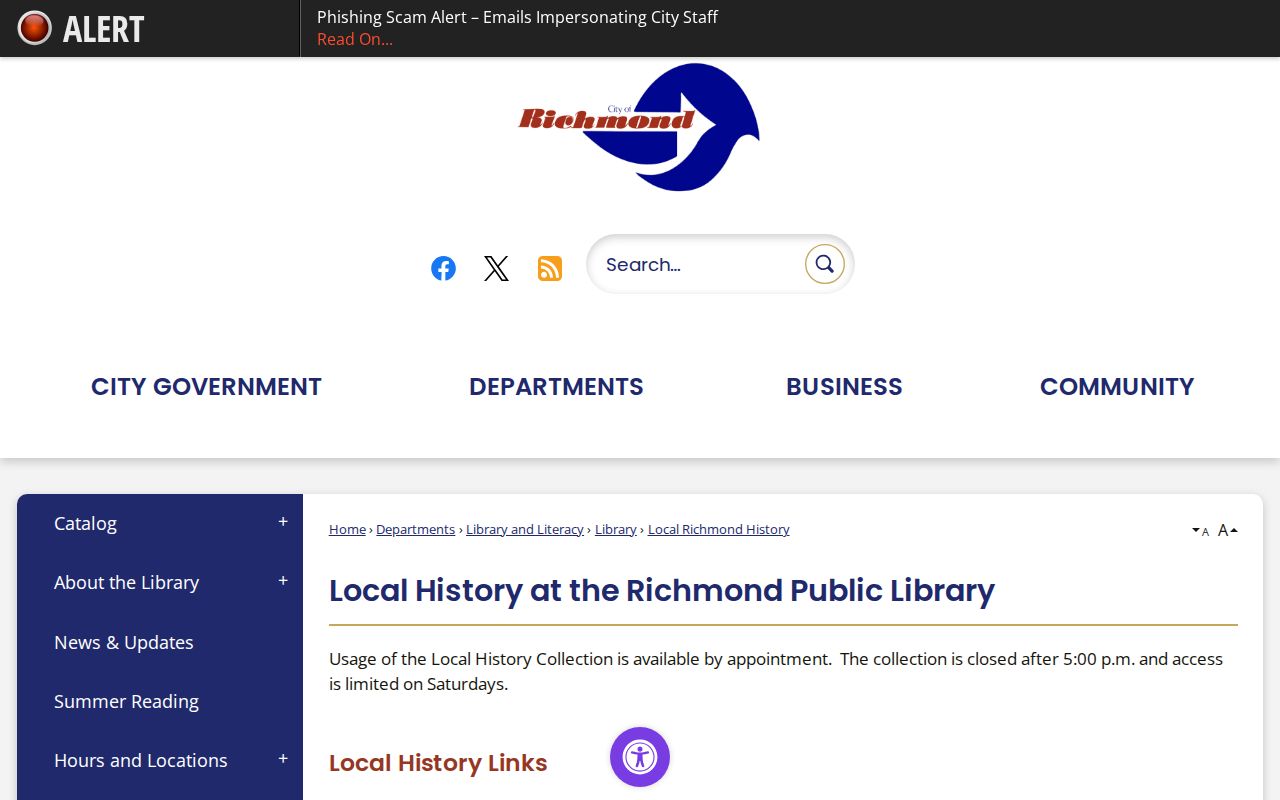
A web lead can save a trip, while appointment rules still matter for the Richmond volumes and companion material that remain on a shelf or in a reading room.
The Richmond Museum research room is open Thu-Sun from 1-4 p.m. by appointment; phone (510) 235-7387. Staff do not conduct research without a paid service, so confirm the research-room information, holdings, and reproduction charges before booking. The separate city-directory finding guide controls the shelf list.
Richmond's 1907 Directory Story
Richmond's early directory shelf overlaps with several other records instead of standing alone. The city incorporated in 1905, and rail, port, industrial, and shipyard growth made names, streets, occupations, and organizations change quickly. A directory dating from 1907 sits beside a nearly complete Richmond Union High yearbook sequence reaching back to 1909. The overlap is useful because a name can be checked against school affiliation, a newspaper notice, a photograph, or an oral history without treating any one source as a complete household roll.
| 1907 | The Richmond Museum directory shelf begins; exact volumes and publishers remain a finding-guide question. |
|---|---|
| 1909 | The Richmond Union High yearbook collection reaches back nearly to this year. |
| 1912 | The Richmond Independent newspaper run begins and continues through 1945 in the Museum holdings. |
| 1913 | The Library's Richmond Record Herald holdings begin in August and continue through June 1936. |
That 1907, 1909, and 1910s overlap is a research story in its own right. A printed entry can suggest where to look next, while a yearbook or press item may explain a move, a school connection, a death notice, or a community event. The dates identify the reach of each collection, not an exact life event for any unnamed person.
Reading a Richmond City Directory Entry
A Polk-era Richmond volume is easiest to use when every mark is copied before it is interpreted. The alphabetic section commonly supplies a surname and given name or initial, a spouse in parentheses, a widow notation, an occupation or trade abbreviation, and a residence address. Later issues may add a telephone number. Some volumes also show a homeowner or householder indicator. The entry is a historical clue, not a deed, tax roll, or current-residence record.
| Name | Surname, given name, and initials; preserve spelling and order as printed. |
|---|---|
| Spouse | Parentheses or a spouse reference may connect two entries; a widow mark can open a later obituary or probate search. |
| Occupation | Copy the occupation line and any trade or organization abbreviation without expanding it by guesswork. |
| Address | Record house number and street exactly, including a room or residence mark where shown. |
| Owner or householder mark | Note the symbol if present; the lack of a mark does not establish who owned or occupied the parcel. |
Do not modernize a surname, street spelling, or abbreviation while transcribing. Initials, married names, Spanish compound surnames, and clerical shorthand can change how a later search matches the same household. A directory may follow an adult resident or a business rather than the property owner, so the name, address, and date must travel together.
Note: An address in a directory identifies a listed household or business, not ownership, occupancy, or a complete list of everyone present.
Reading Richmond City Directory Pages
Use three reading passes. Start with the alphabetic or householder index to find a surname. Then turn to the street section, where headings, crossing-street breaks, and house numbers reverse the search from a place. In later Richmond volumes, a criss-cross section may list the address first and place a resident or business after it.
- Householder index
- The name-keyed portion used to locate a head of household or other listed adult; it is a starting point, not a full household census.
- Criss-cross directory
- The reverse, address-order section. Follow the street heading and house numbers, then compare the resident or business line with the alphabetic entry.
- Abbreviation key
- The legend that explains marks such as “h” for house or home, “r” for room or resides, “emp,” and occupation shorthand. Find it before reading a symbol as a fact.
For a house-history question, read the street page after the name page and compare nearby numbers. For family history, do the reverse when a known address is the stronger clue. A missing street section, an omitted number, or a changed spelling calls for a second volume or a companion source rather than a confident conclusion.
Tracing a Richmond City Directory Household
Household tracing works best as a dated sequence. Start with a known address or name, preserve the printed form, and let each source answer one narrow question. The sequence pairs Richmond city directories with census schedules and the local newspaper, probate, deed, and assessment trails that can explain a change.
- Select a known directory year and read both the alphabetic entry and the street or criss-cross pages when present.
- Transcribe the name, initials, spouse, occupation or trade mark, address, owner or householder symbol, and any widow notation.
- Move across the available years. A first appearance can bound an arrival, while a disappearance can reflect relocation, death, marriage, a name change, or omission.
- Search the spouse independently and compare street spelling, house numbers, nearby entries, and any historic address form.
- Pair the directory with the 1910, 1920, 1930, 1940, and 1950 federal census schedules. The census adds household relationship, age, birthplace, and immigration detail; the directory fills some years between those snapshots.
- When a “wid” mark or disappearance raises a question, check Richmond newspapers, obituary and probate files, deeds, or assessment books. Directories do not prove title.
Move to the Richmond resident lookup for a modern identity check. Probate and obituary material can reconnect heirs with family property or unclaimed assets; an old address is not proof of present residence.
Pair Richmond Printed Directories With Census Years
The 1910-1950 census years are especially useful because the federal schedules and directory volumes answer different questions. A census is an enumeration snapshot with household relationships, ages, birthplaces, and immigration detail. A printed directory may appear more often, but its publication date, editorial choices, and address conventions can leave gaps. Compare the two by address and name, not by an assumed annual run.
A directory entry that appears in the early 1940s but not in the 1940 census should prompt a check of publication timing, initials, spouse entries, shipyard-era arrival, Richmond Independent notices, and the 1950 census. It should not produce an invented arrival date. The same care applies when a directory name vanishes: a move, death, marriage, omission, or changed street form may all fit the evidence.
The census also helps separate a listed adult from the rest of a household, while a directory can point toward a street number or occupation clue between census dates. For a property question, pair both with deeds or assessment books. For a family question, add newspapers, yearbooks, obituary files, and probate.
Richmond City Directory Companions at CCCHS
Contra Costa County Historical Society collections extend the historical shelf beyond printed directories. CCCHS holds annual assessment books from 1850-1910, historic court files from the 1850s into the mid-20th century, naturalization material spanning 1850-2008, newspapers, maps, photographs, and a large obituary, biography, and town-clipping file. More than 9,300 historic court files are indexed by names for over 61,000 people. The collection also catalogs more than 1,700 maps and 20,000 images.
The CCCHS collections description is the access channel for finding aids and current instructions. Physical court and probate indexes are not all online. Newspaper searching is available on onsite public computers, while fragile maps may require an appointment. Use a directory date, street, surname, or event to ask for a focused search rather than expecting one index to contain every name.
The Contra Costa Local History Connection supplies a digital layer for selected maps, photographs, and clippings.
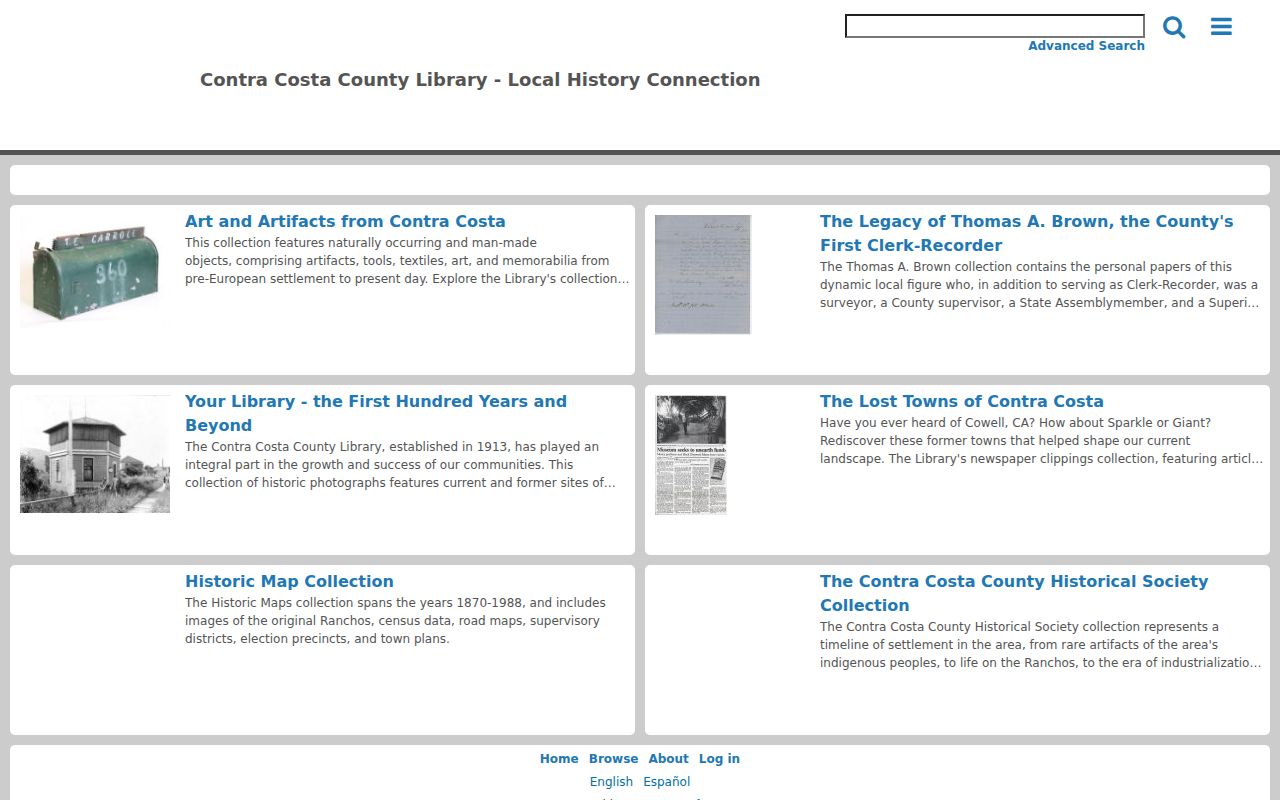
Use a digital item to identify a likely source, then confirm its date, context, and physical access with CCCHS before treating it as evidence about a household.
Richmond Directory Clues in Press and Yearbooks
Local press and school yearbooks add human context that a directory cannot supply by itself. The Richmond Independent run in the Museum holdings covers 1912-1945. The Library holds the Richmond Record Herald from August 1913 through June 1936. Those pages may carry notices, community events, school items, obituaries, and address clues that explain why a printed entry changes.
The Museum's nearly complete Richmond Union High yearbooks back to 1909, together with the Library's Harry Ells, Richmond High, and John F. Kennedy High series, can connect a name with a class or school year. Richmond's World War II Home Front collections, including Rosie the Riveter community stories and oral histories, add context for shipyard-era movement. Use those sources to form a question, then verify it against a dated record.
When a Richmond Directory Trail Goes Quiet
A final appearance is not a known departure date, and a missing year is not proof that a household left Richmond. Check the next volume, the spouse's name, the street section, alternate initials, and older or newer street forms. A “wid” notation may point toward an obituary or probate file. A changed address may reflect a move, subdivision, annexation, or a numbering change while the legal parcel remains continuous.
For older Richmond addresses, compare the directory with historic maps, assessment books, deeds, and local press. For modern address-keyed work, the Richmond street directory workflow can keep parcel and street evidence distinct from the historical household trail. Record the source, date, page or index location, and remaining uncertainty.
Note: A missing directory entry is a lead for another source, not proof that a household left Richmond.